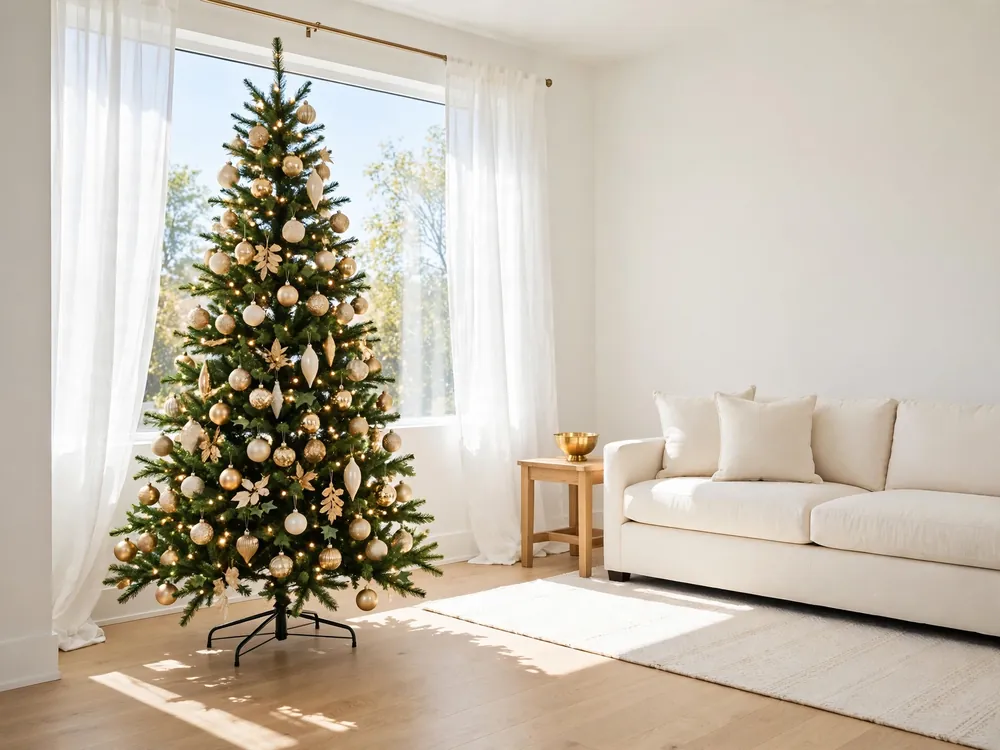
Every year, christmas tree home decor becomes this source of quiet stress for people living in smaller spaces — I hear it constantly from readers who love the idea of a beautiful tree but feel like their living room just won’t cooperate. You pick one that feels right in the store, drag it home, set it up in the corner, and suddenly half the room is gone. It stops feeling festive and starts feeling cramped.
I’ve spent years watching designers handle this exact problem, and the fixes are simpler than most people expect — no drastic room overhauls, no sacrificing the tree you actually want. In this article, I’m walking you through ten christmas tree decorating ideas that real designers use specifically in tight, awkward, or small spaces, so you can have a tree that looks intentional, styled, and genuinely beautiful — not like an afterthought squeezed into a corner.
How Designers Approach Christmas Tree Home Decor Differently in Small Spaces
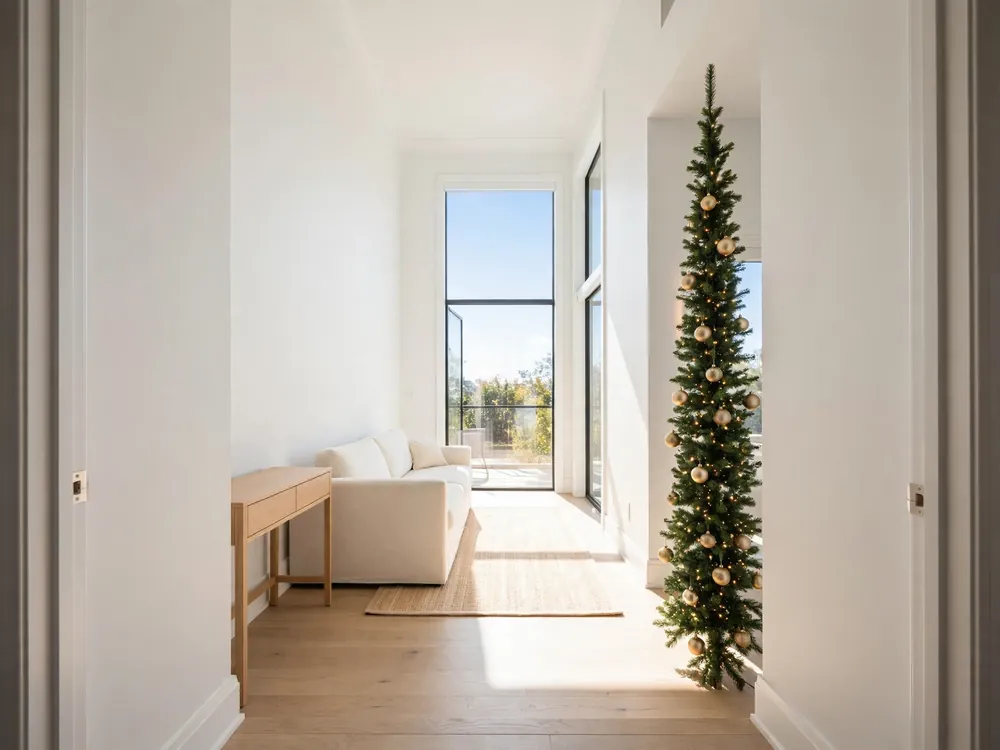
Most homeowners treat a small living room like a puzzle — they’re trying to fit the tree in. Designers think about it completely differently. They’re asking what the tree needs to do for the room, not just how to squeeze it into a corner.
I noticed this shift in thinking when I styled a client’s 11-foot-wide living room a few years back. She had already picked her tree. My job wasn’t to talk her out of it — it was to make the whole room work around it intentionally.
That’s the real difference. Designers treat christmas tree home decor as part of the room’s layout, not an addition to it. The tree becomes a design anchor, not a decoration dropped into empty space.
So what actually changes? A few things designers consistently do differently in tight rooms:
- Scale before sentiment — they choose tree size based on ceiling height and sightlines, not nostalgia
- Vertical over wide — slim profiles that draw the eye up instead of pushing furniture out
- Negative space on purpose — leaving breathing room around the tree so it reads as styled, not stuffed in
A lot of these overlap with the small space Christmas tricks I cover elsewhere, but the tree specifically deserves its own set of rules.
The mindset shift is simple: design around the tree, don’t apologize for it.
1. The Corner Slim Tree Styled to Feel Intentional, Not Like an Afterthought
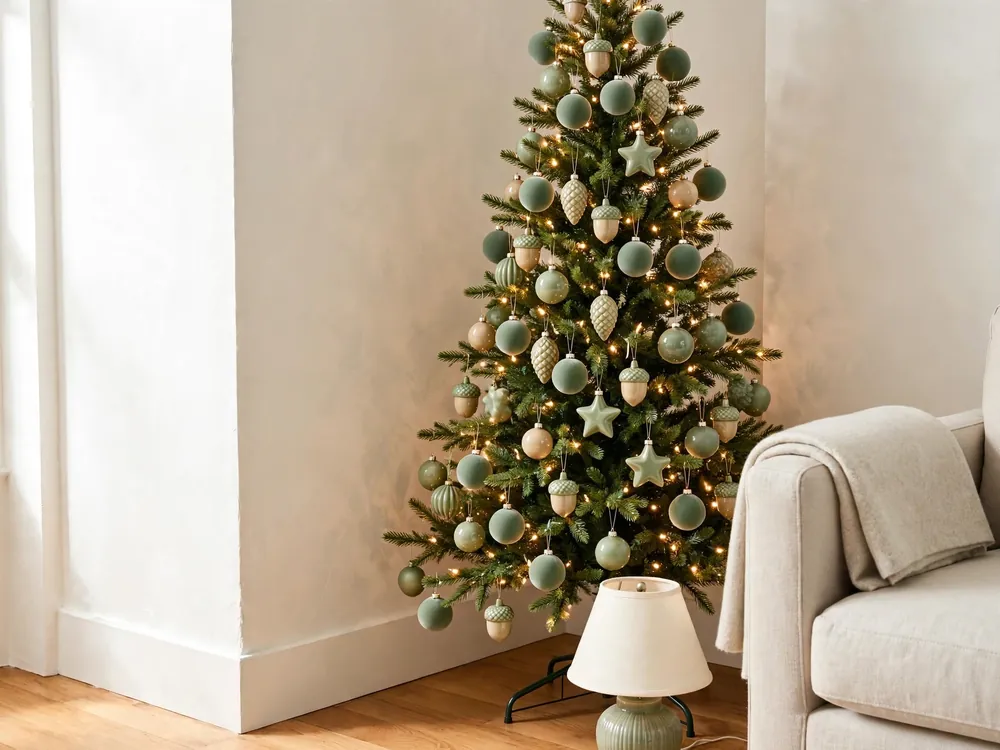
The slim tree in the corner gets a bad reputation. People assume it looks like a compromise — like you wanted a full tree but settled. That’s almost never true when it’s styled right.
Here’s the fix: the tree isn’t the problem. The styling around it is.
I worked with a client in a narrow row house in Philadelphia — her living room was barely 10 feet wide. She’d bought a 6-foot slim tree and shoved it in the corner, ornaments on, skirt down, done. It looked forgotten. So we pulled it two inches from the wall, angled it slightly toward the room, and suddenly it had presence.
That small shift changes everything. A tree flush against a wall disappears into it. Give it just a few inches of breathing room and it reads as a placed object, not a squeezed-in one.
For the decorating itself, I always tell people to go front-heavy on ornaments — not all the way around. On a slim tree, the back half won’t be seen anyway. Load the visible third with your best pieces. It looks fuller than it actually is.
If you’re pulling ideas from small apartment decor ideas, you’ll notice the same principle everywhere: draw the eye to what you want seen and let the rest recede.
This is christmas tree home decor done with intention — not desperation.
Quick tip: Place a warm-toned lamp near the base of a corner tree to cast upward light and make it look twice as full.
2. The Tabletop Tree That Anchors a Vignette Instead of Standing Alone

Tabletop trees get dismissed fast. People assume they’re a kids’ room thing, or a last resort when you ran out of floor space.
That’s backwards. A tabletop tree placed intentionally can anchor a whole corner of a room — better, honestly, than a floor tree shoved in awkwardly.
The mistake I see constantly? People set the tree on a table and call it done. Bare base, nothing around it, just a small tree sitting there looking lonely. That’s not christmas tree home decor — that’s a tree waiting to be decorated.
The fix is treating it like a vignette anchor, not a standalone object. A few years ago I styled a 9-by-11 living room where floor space was genuinely impossible to spare. We put a 24-inch tree on a side table, then built around it — a stack of two small books underneath to lift it, a lantern to the left, a small bowl of ornaments at the base.
Suddenly it had weight. It looked like it belonged there.
If you want the process spelled out, the same rules that apply to table vignette styling ideas work perfectly here — vary heights, odd numbers, one natural element.
The tree becomes the tallest piece. Everything else layers down from it.
Worth knowing: Wrap the table base in a small linen runner or a piece of faux fur to ground the whole vignette and make the setup feel finished rather than floating.
3. The Wall-Leaning Flat Tree That Frees Up Floor Space Without Sacrificing Impact
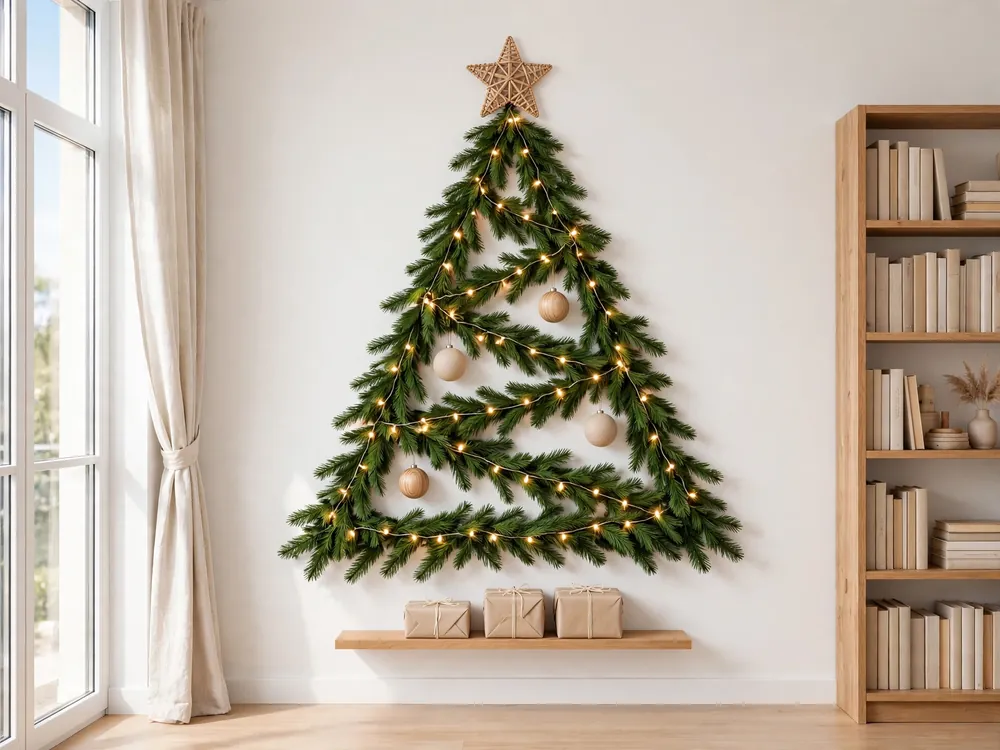
This one surprises people every time I mention it.
A flat, wall-mounted tree — made from branches, garland, or even washi tape — takes up literally zero floor space. Nothing to trip over. Nothing eating into your walking path.
I first tried this in a client’s studio apartment in Chicago. She had about 8 feet of wall between her window and bookshelf, and floor space was completely off the table. We used overlapping pine garland pinned into a triangle shape directly on the wall, added small clip-on lights and a handful of ornaments, and stepped back.
It looked like christmas tree home decor pulled from a magazine spread. Not a workaround. Not a craft project. An actual design moment.
The key is committing to the triangle shape. Loose, droopy garland reads as lazy. Pull it taut, anchor each layer to the wall with Command strips, and keep the silhouette tight from top to bottom.
Lighting matters more here than on any floor tree. Since the “tree” has no depth, the lights have to do the dimensional work. I recommend layering two strands — one warm white, one slightly cooler — for that slightly imperfect, organic glow that stops the wall version from looking flat.
For ornaments, stick to five or fewer. Too many and the wall gets busy. A few well-placed pieces and a simple star at the tip is all it needs.
Pro tip: Add a small shelf at the base of the wall tree to hold wrapped gifts — it tricks the eye into reading the whole setup as a full, grounded display.
4. The Monochromatic Christmas Tree Decorating Idea That Makes a Small Room Feel Larger

Color is doing more work in a small room than most people realize.
When you mix three or four ornament colors on a tree in a tight space, your eye jumps around constantly. That visual noise makes the room feel busier and smaller than it actually is.
Single-color trees fix this completely. I learned this firsthand styling a 12-by-14 living room in Toronto — the homeowner had a gorgeous mix of red, gold, green, and silver ornaments she’d collected for years. Beautiful individually. Together, on a slim tree in a small room, it looked chaotic.
We pulled everything off and rebuilt using only champagne and ivory tones. Same tree. Same room. It suddenly felt like it had room to breathe.
The reason this works ties directly into monochromatic room styling tips — when there’s no color competition, the eye reads the whole tree as one calm shape instead of scanning every ornament individually.
For christmas tree home decor in a small space, I always tell people to pick one base color plus one metallic. That’s the entire palette. Matte ornaments plus one shiny tone gives you enough variation to look intentional without adding visual clutter.
Texture is where you add interest. Mix velvet, glass, and woven ornaments in the same hue and the tree looks rich without being loud.
Quick tip: All-white or all-cream ornaments with warm Edison-style lights will make a small room feel about 30% more open — the light bounces softly instead of catching on competing colors.
5. The Layered Lighting Approach Designers Use to Make Any Tree Look Twice Its Size
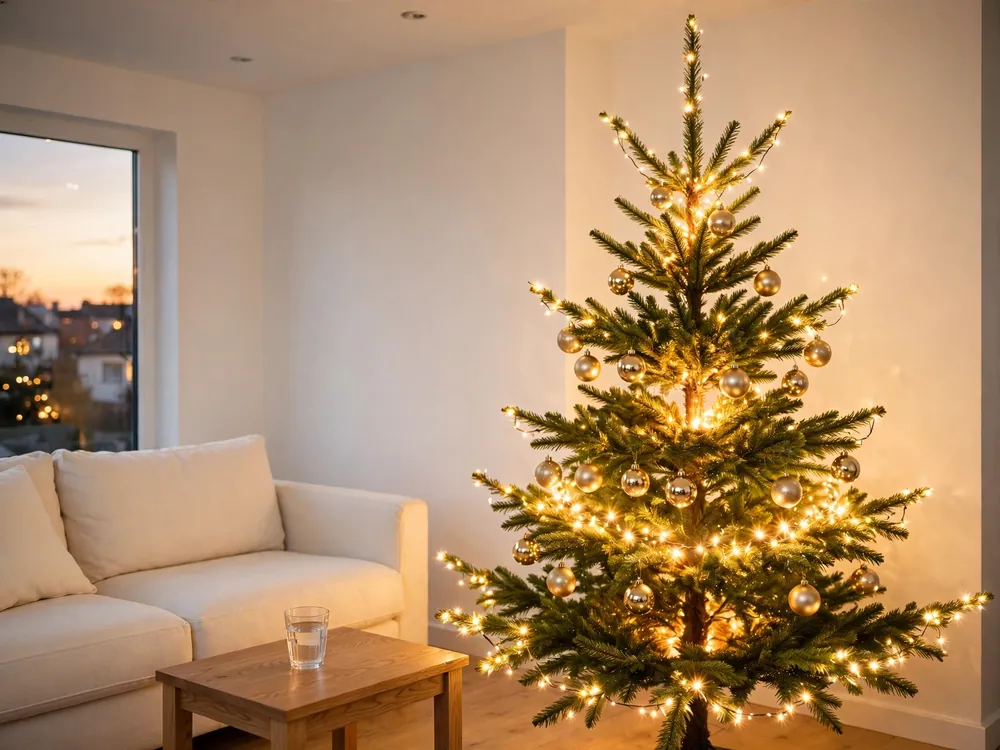
Lighting is the most underused tool in christmas tree home decor — and it’s the one that makes the biggest visual difference in a small room.
Most people buy one strand of lights, wrap it evenly around the tree, and call it done. The result is flat. Every branch looks the same depth. The tree reads as a silhouette, not a dimensional object.
Here’s what actually works: three separate light placements, not one.
I started doing this after a client in Seattle pointed out that her neighbor’s tree always looked fuller — same slim tree, same small living room. We went to look. The difference was the neighbor had tucked one strand deep into the branches near the trunk, wrapped a second around the mid-layer, and draped a third loosely at the outer tips.
That inner strand is the secret. It creates depth from behind the branches, which tricks the eye into reading the tree as much wider than it is.
If you’ve ever looked at layered fairy light designs and wondered why they look so dimensional, this is exactly the technique — near lights and far lights working together.
Stick to warm white only for small spaces. Cool white or multicolor bounces light in competing directions and makes a compact tree look scattered.
Dim the overhead room lights once the tree is lit. Suddenly it has presence. It pulls the whole corner forward without taking an extra inch of floor space.
Quick tip: Push a few branches slightly apart near the trunk before inserting the inner strand — even a half inch of gap lets the light bloom outward instead of sitting flat against the bark.
6. The Curated Ornament Edit That Replaces Volume With Visual Interest

More ornaments does not equal more impact. I had to learn that the hard way.
A client in Austin showed me her tree one December — a 5-foot slim artificial covered in roughly 140 ornaments. Every branch was loaded. It looked exhausting, not festive. The tree had no focal point because every single spot was competing for attention.
We pulled off two-thirds of them. Kept about 45, all intentionally placed.
The result? The tree suddenly had breathing room. You could actually see the branches. The ornaments that stayed looked like they mattered.
That’s the real shift in christmas tree home decor for small spaces — editing down instead of layering up. Less stuff, more intention.
Here’s how to approach the edit:
- Pick a hero piece — one ornament that anchors the whole tree, usually placed just above center where the eye naturally lands first
- Cluster in threes — group ornaments in odd-numbered clusters rather than spreading them evenly, which reads as decorated, not scattered
- Leave bare patches — a few gaps between clusters let the lights show through and give the tree actual depth
Sound familiar? This is exactly how you’d edit a shelf vignette — pull back until the best pieces finally get noticed.
The christmas tree home decor mistake isn’t owning too many ornaments. It’s using all of them at once.
Quick tip: Store your pulled ornaments in a bowl nearby — they double as a table vignette and make the whole room feel coordinated.
7. The Tonal Ribbon Technique That Adds Structure Without Clutter
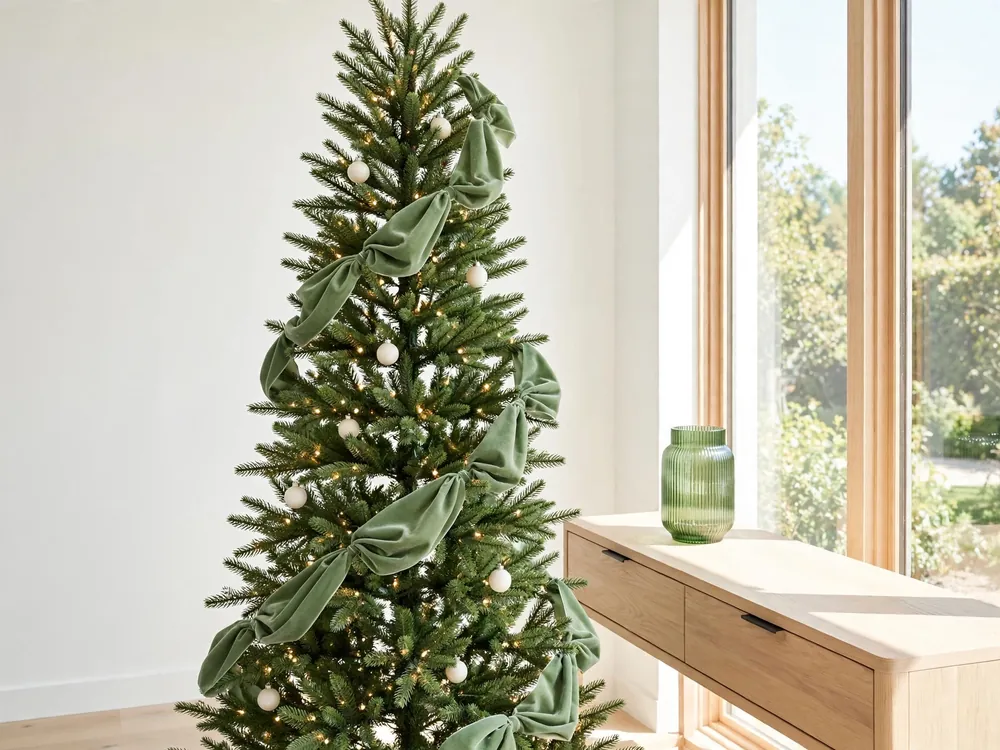
Ribbon is the piece most people skip. Too fussy, they think, or it just ends up looking like a wrapped gift exploded on the tree.
The problem isn’t the ribbon. It’s using the wrong kind in the wrong way.
I made this mistake for years — buying wide, shiny ribbon, threading it through branches, and ending up with something that looked costumey rather than styled. The fix was switching to tonal wired ribbon, about 2.5 inches wide, in a texture that matched the tree’s color family. Velvet in a muted sage. Linen in off-white. Burlap in warm oatmeal.
Not a bow in sight. Just soft loops.
Here’s how I actually do it: cut the ribbon into 12-inch segments, fold each loosely, and tuck the base into a branch rather than tying it. It drapes naturally instead of looking pinned on. Place five or six segments in a loose diagonal from top right to bottom left — the eye follows the line and the tree suddenly has movement without extra ornaments.
This is exactly the kind of approach behind luxury Christmas decor without clutter — structure that reads as intentional, not decorated.
In a small room, that diagonal placement also makes the tree look taller than it is. Same christmas tree home decor, more visual height, zero extra floor space needed.
Quick tip: Stick to one ribbon texture per tree — mixing satin with burlap on the same branches kills the calm effect you’re going for.
8. The Bookshelf or Nook Placement That Turns Dead Space Into a Feature
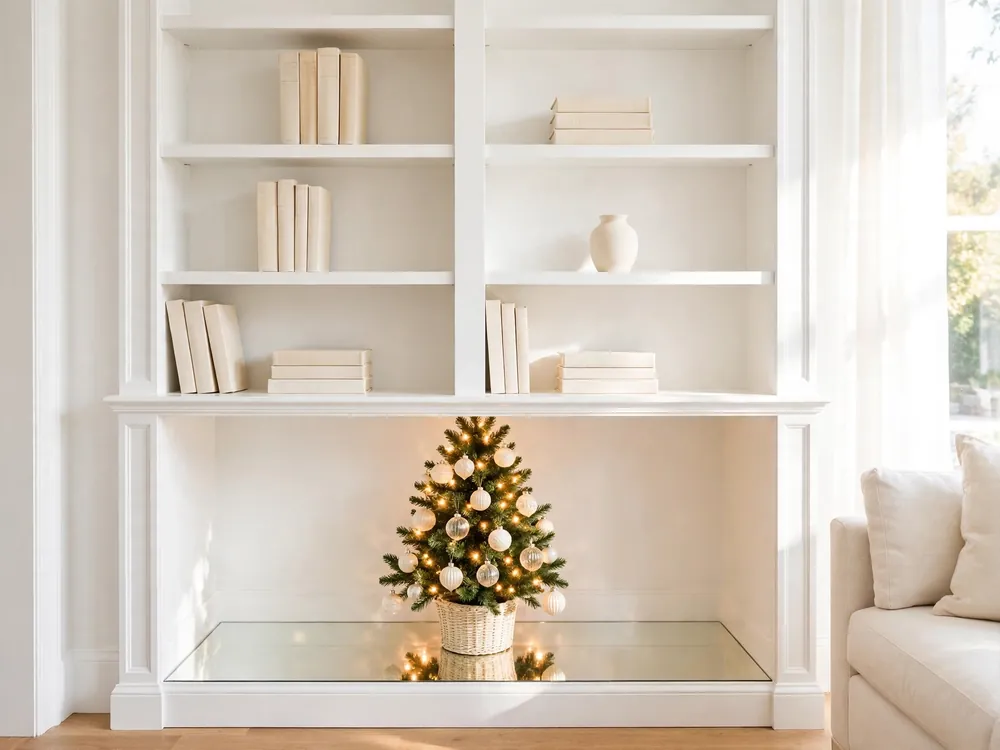
Dead corners are wasted potential. Most homeowners walk past them every day without realizing they’re sitting on the best christmas tree home decor placement in the room.
I discovered this accidentally while styling a client’s living room in Vancouver. She had a built-in bookshelf with one empty lower bay — about 24 inches wide and 14 inches deep — that she’d been using to stack old magazines. We pulled everything out, slid in a small 3-foot pre-lit tree, and suddenly that forgotten corner had a reason to exist.
The shelf frame did something a standalone tree couldn’t. It contained the tree visually, so instead of a small tree looking small, it looked placed. Like it was always meant to be there.
Same principle works for alcoves, reading nooks, even the space beside a fireplace mantel. Any recessed spot that usually collects clutter can hold a tree instead — and the surrounding walls act like a natural frame.
For anyone exploring creative tree display ideas that go beyond the obvious corner setup, this nook approach keeps coming up because it genuinely solves two problems at once: the tree gets a home, and the dead space finally gets a purpose.
Keep ornaments facing outward only — the back of a nook tree is invisible anyway, so decorating it wastes time and weight.
Quick tip: Line the shelf base with a small mirror tile before placing the tree — the reflection doubles the light and makes a compact tree look twice as full.
9. The Statement Topper That Does the Heavy Lifting When the Tree Is Short

A short tree doesn’t have to read as short. That’s the whole game here.
I learned this working with a client in Portland who had a beautiful 4.5-foot tree and a 9-foot ceiling. She kept apologizing for it. Once we put a dramatic 14-inch star topper on it — matte brass, slightly oversized — nobody looked at the tree’s height. They looked at the topper.
The eye follows the highest point in the room. Give it something worth landing on.
Most people buy a topper that’s proportional to the tree. Designers do the opposite in small spaces — they go slightly bigger than feels right, because an oversized topper pulls the whole tree upward visually, adding perceived height without adding actual inches to the base.
This shows up constantly in aesthetic Christmas decor ideas that photograph well — the topper is almost always doing more structural work than it looks like.
For christmas tree home decor in a tight room, I recommend skipping the traditional bow or small star. Go with something with actual silhouette — a sculptural star, a feathered angel, a bent twig cluster. Something that reads clearly from across the room.
Keep the top third of the tree lighter on ornaments so the topper isn’t competing with everything below it.
Quick tip: Wire the topper to the top branch before decorating — a heavy topper added last will tilt, and a crooked tip kills the whole upward effect you built.
10. The Christmas Tree Styling Trick of Repeating One Element Throughout the Room

This one is so simple it almost feels like cheating.
Pick one element from your tree — a specific ornament color, a sprig of eucalyptus, a ribbon texture — and repeat it in two or three other spots around the room. On the mantel. In a bowl on the coffee table. Tucked into a bookshelf.
I tried this in a client’s narrow living room in Edinburgh a few winters ago. She had deep burgundy ornaments on her tree and nothing else in the room that touched that color. The tree looked isolated — like a decoration dropped into a space that had nothing to do with it.
We pulled three burgundy ornaments off the tree and set them in a small glass bowl on the side table. That was it. Suddenly the tree felt connected to the room, not foreign to it.
That’s exactly what makes a layered cozy Christmas room work — the tree isn’t doing all the decorating alone. It’s one piece in a coordinated whole.
In a small space, this matters even more. A tree that visually ties into its surroundings reads as intentional christmas tree home decor. A tree that doesn’t tie in reads as furniture you’re temporarily tolerating.
You don’t need to redecorate the room. Just echo one thing, three places. The eye connects the dots and the whole space feels designed.
Quick tip: Use the ornaments you edited off the tree in tip six — they’re already the right color and they’re just sitting there.
Common Christmas Tree Decorating Mistakes That Make Small Spaces Feel Crowded
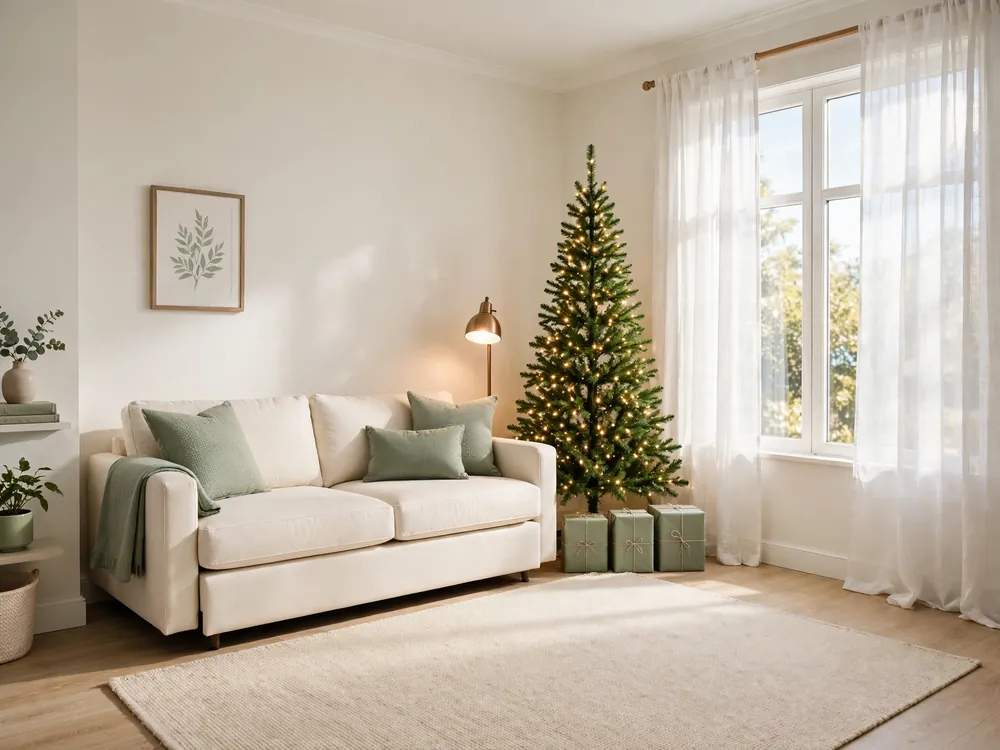
Most people decorating a small living room make the same handful of mistakes. Every single time.
I’ve walked into enough tight spaces mid-December to have a running mental list. The mistakes aren’t random — they cluster around a few patterns that consistently make rooms feel smaller and messier than they actually are.
Here’s what I see most often:
- Choosing a tree by height alone — a 7-foot tree with a 24-inch spread still takes over a small room, even if the ceiling clears it
- Skipping the furniture edit — pulling a sofa even 8 inches forward before adding a tree makes a real difference; most people don’t touch anything
- Overloading the skirt area — piling gifts all the way to the furniture edge closes off what little floor space you had left
- Mixing light temperatures — warm white on the tree and cool overhead lighting creates a visual clash that makes the whole corner feel unsettled
- Matching tree size to the wall, not the furniture — a tree that’s taller than your sofa back will dominate the sightline regardless of the room’s square footage
The good news? None of these require starting over. A few small adjustments — the kind behind simple Christmas decor that works — fix most of them in under an hour.
Good christmas tree home decor in a small space isn’t about doing more. It’s about doing fewer things better.
Final Thoughts on Making Small-Space Christmas Tree Decor Look Designer-Approved
Small spaces don’t need small ambitions. That’s the thing I want you to walk away remembering.
The designers I’ve watched work in tight living rooms aren’t doing anything magical. They’re just making deliberate choices — about scale, about editing, about where the eye lands — instead of defaulting to habit.
Every tip in this article came from a real room, a real frustration, a client who thought their space was the problem. It never was. It was always the approach.
You don’t need to buy a new tree. You don’t need to gut the room. Pulling a tree two inches from the wall, switching to a single ornament palette, tucking one strand of lights near the trunk — those small shifts are what separate christmas tree home decor that looks styled from decor that just looks present.
If you want to go deeper on the principles behind all of this, the designer Xmas decor secrets I reference are worth bookmarking before you start decorating.
The last thing I’ll say: edit ruthlessly. The trees that stopped me cold — in client homes, in magazine shoots, in a neighbor’s window at 9 PM — were never the fullest ones. They were the most considered ones.
That’s what good christmas tree home decor in a small space actually is. Not more. Just better.